AI Customer Support Service Firm or In-House Software?
The right choice depends on who will own the inbox, update the approved answers, and step in when automation needs help.

When should you hire an AI customer support service firm?
Consider a service firm when you need someone to design, monitor and improve the support workflow and no one on your team can own that work. Use in-house software when you already have a support lead who understands your policies and can review exceptions. A fixed-scope setup project can bridge those two options.
The difference shows up after launch. If your return window changes on Monday, someone has to update the assistant's answer, check it and tell the team what to do with cases from the previous week. Ask who does that work before agreeing to a service.
What should you compare in each proposal?
Bring the same three sample conversations to every provider. Use one routine question, one complaint and one request for an exception. Ask who writes the answer, who handles the exception and where your employee sees it. Compare those responsibilities with what your team can actually cover.
- Setup only. The firm configures a narrow workflow, documents it and trains an internal owner.
- Ongoing managed service. The firm runs agreed checks, reports what it finds and owns specific improvements.
- Software plus internal ownership. Your team controls rules and approves changes. Budget time for monitoring and policy updates.
NIST's generative AI guidance recommends post-deployment monitoring and mechanisms for human override. Use the proposal to make that responsibility concrete, including who pauses the system when a bad answer reaches a customer. NIST, 2024
What does a low-risk first engagement look like?
Give a provider one channel and a narrowly defined job for a short pilot. Agree in advance on what a good answer looks like, which requests require a person, how to export the conversation history and what you can keep when the agreement ends.
Suppose a small retailer owns its weekend support queue but wants help setting up repeat delivery questions. A firm could help prepare approved answers and train the internal lead in a tool such as CatchGrow. At the end of the pilot, the retailer should be able to change the delivery answer and test it with a fresh conversation.
Use the AI customer support guide to choose the work and the small pilot guide to define success. If you want to estimate the payback, start with the missed inquiries and staff time calculation.
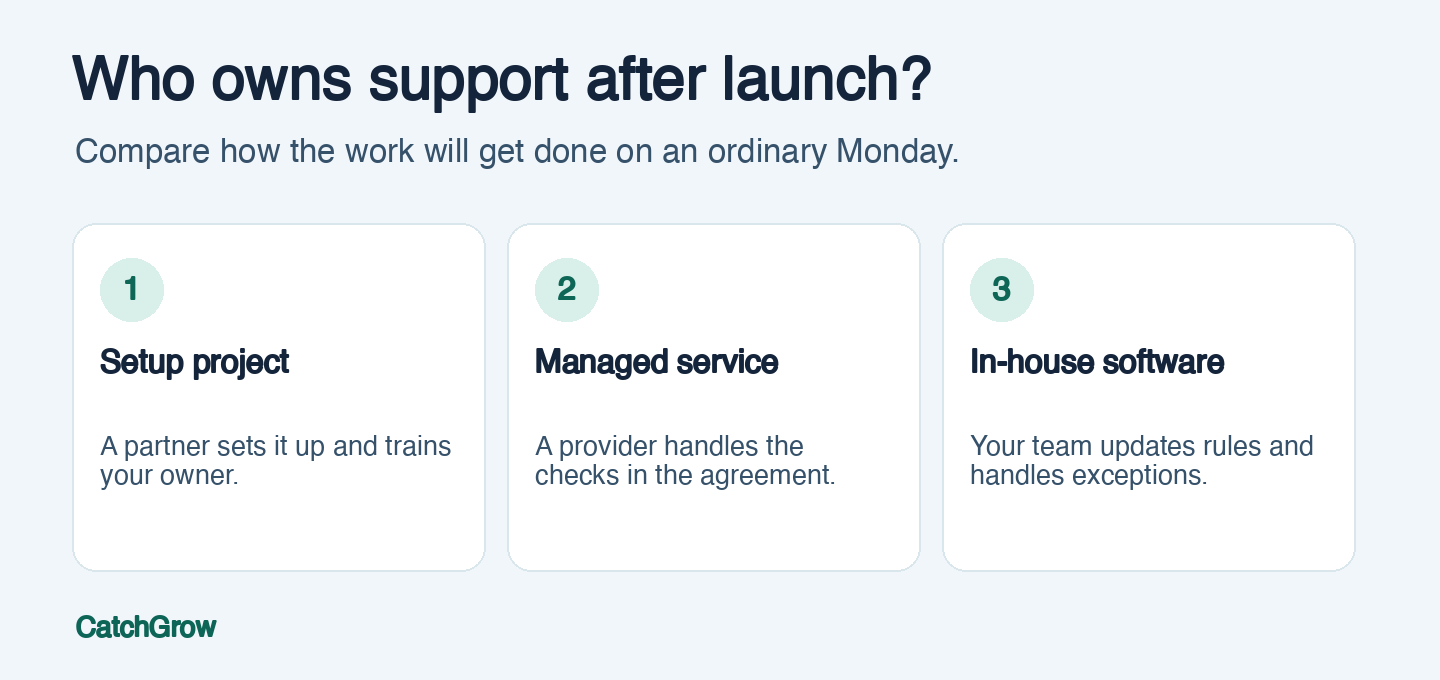
Photo by Nataliya Vaitkevich via Pexels.
FAQ
What does an AI customer support service firm do?
A firm may design workflows, configure software, supply staff or manage ongoing review. Ask which responsibilities appear in the agreement and who handles anything outside them.
How can I compare the total cost of a firm and software?
Compare setup, software, usage, ongoing service and the internal staff time each option requires. Evaluate the same volume and channels for both.
What should we keep if we change providers?
Agree on access to approved answers, workflow rules, conversation exports and operating instructions. Confirm what your team can use without returning to the provider.