Custom AI Chatbots: How to Teach One Your Business Rules
A useful custom chatbot knows which facts it can verify, how your team speaks, and when a teammate needs to get involved.

What makes an AI chatbot custom to your business?
A custom AI chatbot uses your approved information, tone, and rules about which actions it can take. Start by writing down the answer to the repeat question and the exception that changes it. A store can teach the chatbot its standard return window and route an open-box return to the person who can decide.
Use source documents people already trust. If two documents disagree, assign someone to decide which one the assistant should use. Give that person a way to update it and run a fresh test when it changes.
What should you put into the chatbot's knowledge base?
Give each common question an approved answer and an owner. Add the source, effective date, and exception in plain language. This lets the next employee see why an answer exists and what should happen when a customer asks about a case outside the policy.
- Facts. Product specifications, opening hours, published return rules and approved service areas.
- Tone. A few examples of how your team greets customers, explains a policy and asks for missing details.
- Boundaries. What must go to a human and which facts need live verification.
NIST describes how generative AI can produce confidently stated errors and calls for ongoing monitoring. Put one unsupported question in your test set to see whether the assistant asks for help. NIST generative AI profile, 2024
How should you test a custom chatbot before launch?
Test the same rule with an ordinary question, a vague version and an exception. Check that each answer matches the source and takes the right next step. If you serve customers in multiple languages, run the same examples in each language your business actually supports.
Consider a local furniture shop using CatchGrow. It could start with its delivery policy and a test question from a shopper asking for a location outside the coverage area. A useful reply acknowledges the request, collects the location, and hands it to someone who can check.
Use the pilot guide to set a baseline, the handoff guide to define exceptions, and the ecommerce chatbot guide to choose the first questions.
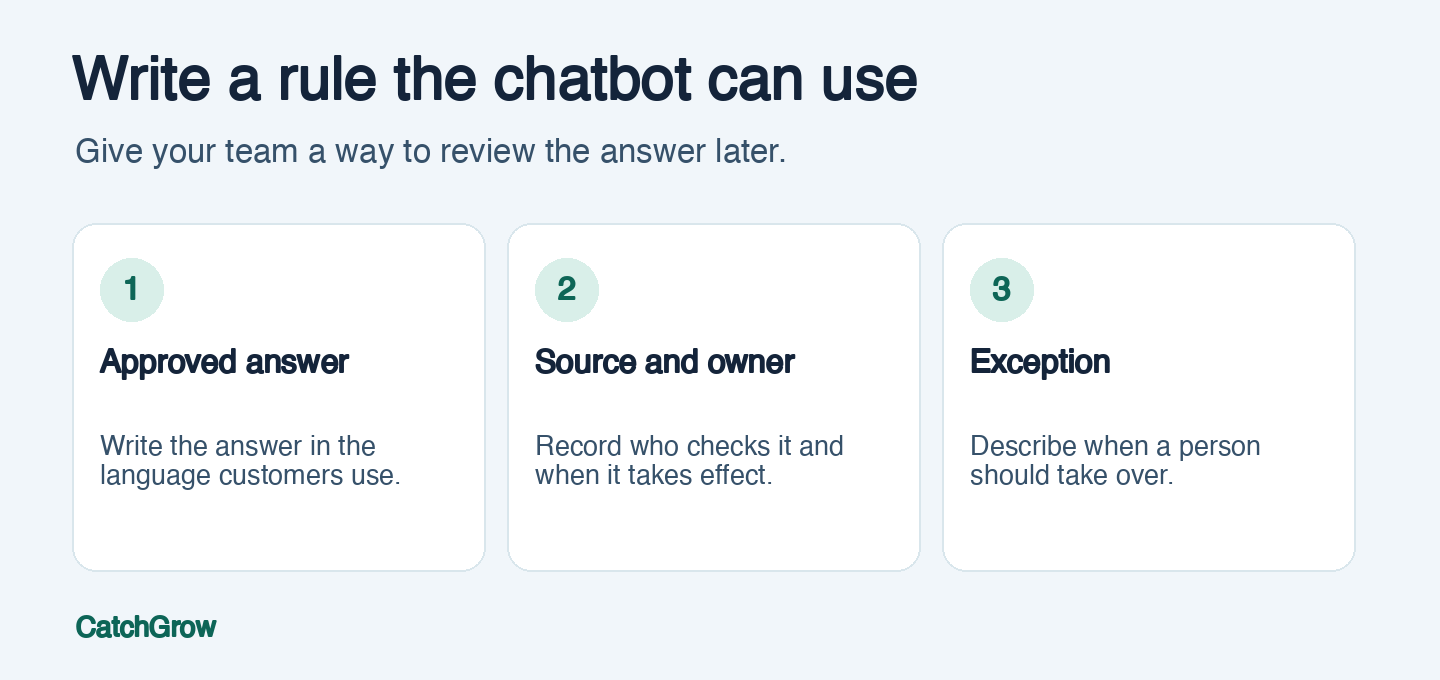
Photo by Mikhail Nilov via Pexels.
FAQ
Do I need custom code to build a custom AI chatbot?
Many business use cases can start with a hosted platform, approved knowledge, and clear rules. Custom development may be useful when the assistant needs to access a system the platform cannot connect to.
How long does it take to train a chatbot on our business?
The setup depends on how complete your approved answers are. Starting with a small set of verified topics makes testing and review easier.
How often should we update the knowledge base?
Update it whenever the source policy, prices or product details change. Ask the old question in a fresh conversation to check that the new answer is used.